Latest Posts

Process of building a character #books #writingtips

If you want to write a novel, you will need well rounded and believable characters to pull your readers along with the story.  For readers to care what happens at the end of a book, you will need to forge a connection between them and your characters.

Different authors will have a variety of different approaches to constructing characters for their novels.  Some will take a more ad-hoc approach, and develop them along the way.  But for myself, if I am going to create realistic characters, it is important to map out their characteristics at the planning stage of a novel – after all, you wouldn’t start writing a book without knowing what your plot is going to be, so why should the characters be any different?  They are just as vital to your novel so it is worthwhile spending some time on character development before you start writing.   These are the stages I go through when putting my characters together – you can play around with the order, nothing here is set in stone.

eyes from Sheknows.compicture from sheknows.com

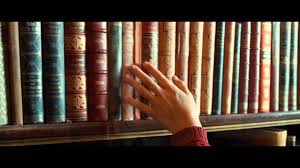
Appearance:  Okay, let’s start off with an easy one.  I imagine you already have an idea in your mind’s eye what your character looks like, but try and describe him/her in writing now.  This will make it easier later on, when you will need to describe them in the novel.  Also include as many details as you can, such as colour of eyes, skin complexion, height, and timbre of voice.  You might not need all these details for your novel, but it’s good to have them there now to help you imagine them in scenes later on.

traits from Imgur.compicture from imgur.com

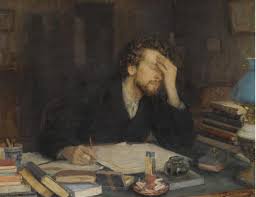
Traits and oddities:  This can be a limp, lisp, or a simple mannerism of your character, such as their general turn of phrase, or the particular way they might flick their hair, or any distinguishing trait.  However, be warned, you don’t need to do this section for all your characters!  Don’t give all your characters an odd mannerism for the sake of it, or your novel could end up becoming a very strange book indeed!
Breaking chainspicture from cliparthut.com

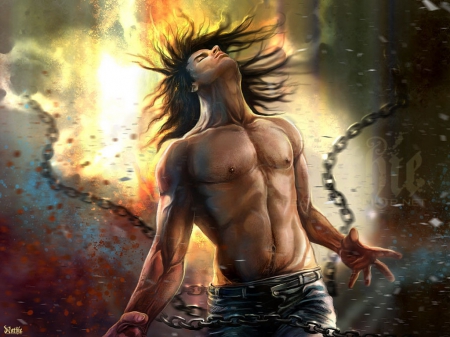
Strengths and weaknesses:  A lot of authors are very good at the first part of this, and can reel off all their main characters strengths – good with a sword or gun, charming and funny, clever and quick-witted. What they are less good at is defining their weaknesses, but it is just as important to concentrate on this aspect as we are all flawed in someway.  A large ego, a fear of confrontation, a tendency to become maudlin when deep in their cups, or an inability to admit when they’re wrong, all can add depth to your character.   If you want to create somebody who appears realistic, you will need to spend just as much time on the darker side of their personality.  It will also give your novel so much more scope to develop if you know both sides of their character.

For example, in my novel Roman Mask, I started off by highlighting my main characters weaknesses.  Then as the story progresses, and he grows with the story, I could slowly draw more from the strengths of his personality.  This means that you can see a progression in his personality, as he slowly recovers from the tragic events that put him in a lowly state.

This can easily work the other way round.  For example, you could have a well-meaning politician who starts the book full of idealism and great ideas as his vision and intelligence gives him\her the desire to help people.  Later on, their arrogance in thinking that only they are capable of doing the right thing can lead to them being corrupted by the power and prestige of their position.  Either way it shows a progression as the character develops and is a useful tool.

storyteller_from Samsabel.compicture from samsabel.com

Back-story:  It is one thing to invent the type of character you need for your novel, but how did they get there?  For example, you may have constructed a taciturn male detective who excels at deductions and visualising crime scenes, but what made him so adept at this skill?  Was it something from his school years?  What was his family background?  Why did he become a detective?  Was there a personal tragedy that led him down this path?  The more detail you can add at this stage, the more you will be able to relate to the character as a real person as you write your novel, as well as giving yourself an invaluable pool of information to draw upon when you need inspiration for a sub-plot.  One point of warning however, remember that at this stage your readers will not know of this back-story yet as they won’t read the character profiles, so don’t forget to incorporate them into your novel at some point.

Friendly operationrainfall.compicture from operationrainfall.com

Overall impression:  No matter how well you define your characters strengths and weaknesses, and their back-story, you will still need to remember why you created this character in the first place.   For example, if you originally brought them into your novel to act as a light relief from the seriousness of your main character, you will need to make sure that you are sticking to this trait through your novel, and that they’re not just morphing into a lesser version of your main-lead.  Of course your characters can develop in their own direction once you start writing, but be aware that if you originally wanted a cheerful, friendly character who laughs a lot, that you don’t forget this all together.

You may disagree with this entire process, that is completely your prerogative, but it’s good to at least know what works for you and what doesn’t.  At the very least, have a method of your own that you use when you create a character.  Characters are, for me, the bedrock of great writing, so they deserve as much time and effort you can give them.

Readers Favorite! Roman Mask, 5 Stars! #books

dfw-tb-trm-cover-small

You may notice a silver medal on the top right hand side of my blog, showing five stars.  This is from readers favorite, who have awarded me this after reviewing my book, Roman Mask.  Readers favorite are The fastest growing book review and award contest site on the Internet.  They are the recipient of “Best Websites for Authors” awards by the Association of Independent Authors. They are also used by the large publishing houses Penguin, Harper Collins, Random House, and Simon & Shuster among others.

The reason I went to these guys to review my novel, was because I felt it was important to get a completely impartial view on my novel, from a source that is world recognised and renowned for their fair and honest reviews.  Needless to say, I was delighted to receive 5 stars!  They also have an annual book award contest in April, so who knows, I might just take part in that too!

Anyway, here is the review I received:

reader favorite

Reviewed By Cheryl E. Rodriguez for Readers’ Favorite

Thomas MD Brooke narrates a tale of conquest in Roman Mask. Rome is conquering the world, stretching its strength and rule to the north. However, the Germanic tribes are barbaric and aren’t so easily tamed. Cassius Gauis Aprilis is a hero in Rome, renowned for his victory at the Western Gate Pass. Yet Cassius does not feel heroic at all. He is haunted by the blood lust of that battle – the loss of his valiant comrades invades his thoughts. He disguises his shame with wine and women, vowing never to return to Germany. Never say never. Lady Livia, the wife of Augustus, the imperator of Rome, has other plans for Cassius. She desires to know what is really going on in the Roman ruled Germanic province. She commissions him to return to Germany as a spy, masked as an aide to Governor Varsus. Much to Cassius’ chagrin, Marcus Scavea, a young and vibrant soldier, is deployed to accompany and serve him. Cassius must face his fear and return to the land he fights desperately to forget. What awaits him is worse than the nightmare of his past. Friends turn into foes, betrayal and chaos challenge the debilitating fear within him. If Cassius ever wants to return to Rome, his cowardice must submit to courage. 

Roman Mask by Thomas MD Brooke is a fascinating work of historical fiction. Brooke uses artistic expression to create a fictional historic account of the battle of Teutoburg. The battle that proved that Rome was not invincible and Germany would not simply bow down to Roman rule. Brooke is a fluent and eloquent storyteller. He illustrates the trauma of battle in his main character, Cassius, who displays all the symptoms of modern day PTSD. As a reader, I became emotionally entwined with Cassius; his fear, inner turmoil, his search for courage and love, his heart and soul injury as a result of betrayal were all depicted with extreme sensitivity. All of the characters were brilliantly written; they grow, evolve and intersect with each other masterfully.

The setting captured the essence of the ancient landscapes of the time period. The images revealed the collision of Roman civilization and Germanic tribal rule. What intrigued me the most was the theme of the narrative – living a lie is easy when hiding behind an illusionary mask. Both the protagonist, Cassius, and the antagonist, Julius, are written as testimonies to this deceptive idea. In all reality, living a lie is not easy at all. Furthermore, once the masks are removed, the truth is exposed. Cassius sums it up poignantly: “I forgot who I was, and I’d rather be the man I am now than go back to living that lie.”

5star-shiny-web

You can find Roman Mask on Amazon here

10 Great features of a castle #writing #fantasy #history

You can’t beat a castle to form a dramatic setting for a novel.  If you are writing a story from the past, you can steep it with the historical detail so beloved of the genre.  Equally, if you are writing a fantasy novel, you can let your imagination run free as you create a great stronghold.  One of my favourite aspects of George R. R. Martin’s Game of Thrones is the number of incredibly expansive and spectacular castles, all uniquely different, that form the seats of power for all the great families.

If you want some pointers where to start, here are 10 to get you going.

Machicolations _lookandlearn compicture from lookandlearn.com

Battlements and Machicolations.  A few crossbowmen along the battlements go a long way to deter any but the most determined attacker, but if necessary, you can have machicolations – stone boxes that project from the wall and had holes in the floor – ready to pour boiling oil, rocks, or any other nastiness down on the poor unfortunates below.

arrow slit_travelblog orgpicture from travelblog.org

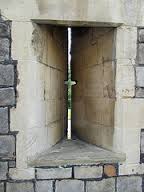
Arrow slits.  Such a simple design disguise what an effective defence these unobtrusive small slits in the curtain wall or towers can be. Built correctly, they will give the archer inside the castle a wide scope for shooting their arrows, whilst the attacker will only have a tiny slit to aim at.

towers and spires_www.chauffeurtourscotland.co.ukpicture from chauffeurtourscotland.co.uk

Towers and keeps. Castle builders can really get carried away here.  Spires, turrets, and a large combination of flanking towers can surround the curtain wall, whilst the main keep should overshadow them all.  The Keep is the last ditch defence of the castle as well as the high lookout point of the castle.  Towers were originally square, as that was easier to build.  When they realised that the corners represented a weak point, later designs incorporated round towers as they were more difficult to tear down.

concentric -Historyonhenet compicture from historyonthenet.com

Multiple curtain walls.  Just as the attackers think they have made it into the fortress, by either climbing over or knocking down the great curtain wall in the way, they find another wall waiting for them – and as this dawns on them, they are trapped in a deadly kill zone or ‘death hole’ as it was called.   Beaumaris Castle in North Wales is a great example of multiple walls forming a formidable defence.

murderholes acrossthepond2007.blogspot.compicture from acrossthepond2007.blogspot.com

Murder holes. Just the name says it all, openings in the ceilings near the gate or in the passage directly behind the gate is where they are usually located, used to pour bloody murder down on the poor unfortunately below.

Gargoyles theartisticlifeofsara.weebly.compicture from theartisticlifeofsara.weebly.com

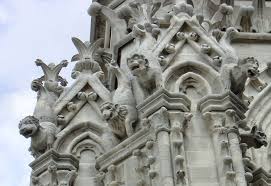
Gargoyles.  If you have an artistic flair, why not disguise your murder holes with a few gruesome stone gargoyles with suitably grotesque features.  Turning an otherwise austere castle into a real gothic nightmare.

Portcullis en.wikipedia.orgpicture from en.wikipedia.org

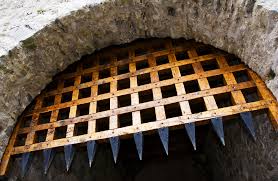
Gatehouse and Portcullis.  Any castle is only as strong as its gate, the saying goes.  Fortunately there are a number of defences that you have on your side.  As well as a drawbridge, you can deploy a Portcullis for rapid closure to your stronghold, a few flanking towers to rain arrows down on your attackers, and second inner gates separated by murder holes.  Your gatehouse can become the strongest point in your fortress rather than its weak point.

Trebuchet en.wikipedia.orgpicture from  en.wikipedia.org

Siege-engines.  As castle designs can become so proficient in repelling invaders, the machines that are needed to gain entry become ever more advanced and cunning.  You have catapults, mangonels, and giant trebuchets to hurl rocks, pitch and fire at (or over) the walls, and siege towers to pour men over the top of them.  Iron shod battering rams with leather clad frames to protect those swinging it can gain you access through the gates or anything but the thickest and strongest walls.

secret passages httphdegitimphoto6.bloguez .compicture from hdegitimphoto6.bloguez .com

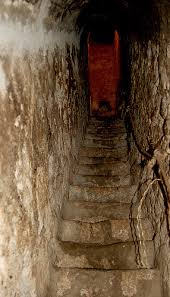
Secret passages. A hidden maze of corridors and stairways existing behind a castle’s thick walls.  A large network of spy holes and listening points can be riddled throughout the great building.  Of course, secret passages are only useful if they remain that way, so liquidation of unfortunate builders may prove necessary.

Ghost hdwallpapers.catpicture from hdwallpapers.cat

Castle ghost.  Every self-respecting castle needs its own ghost.  You need someone to haunt the long cold passageways and make noises in the night.  A suitably tragic back story, full of betrayal and unrequited love can normally be relied upon to be the reason why they’ve return from the grave.

Calling all authors and book reviewers…FREE marketing! #bookmarketing #authors

books2picture from youtube.com

My own novel ‘Roman Mask’ is about to appear on a blog tour of historical fiction websites, through the end of August and throughout September.  It has made me appreciate how important it is for authors to gain the exposure necessary to get a new book up and running.  As I have a website of my own, it only seems fair to make the same offer to other authors in need of marketing their own novels.  So you will see there is an extra tab on my site called ‘Submissions’.  This shows how you can submit a post to my website promoting your own work, providing it is a fantasy or historical novel.  It is completely free of charge; I just need a post that tells the readers something about your novel – it could be the inspiration behind writing the book, or why you were interested in a period of history, or anything really that tells us something about the novel.  I will then post this with a description of the novel and links to where you can buy the book.

I also extend this offer to anyone who wants to submit a review of any fantasy or historical novel.  I’ve never been very good writing reviews myself (I think I’m too soft), but I appreciate the vital role they provide in guiding readers in a busy marketplace.  So anyone who wants to submit an opinion on a novel, please send me your posts.

As for my own blog tour, here are the details.  It will be a mix of my own posts, excerpts, reviews of my novel Roman Mask, and giveaway offers for the paperback version of my novel.

BLOG TOUR SCHEDULE

Monday, August 24
Kick Off & Giveaway at Passages to the Past

Tuesday, August 25
Excerpt & Giveaway at Let Them Read Books

Wednesday, August 26
Spotlight at A Literary Vacation

Tuesday, September 1
Spotlight at Curling up by the Fire

Wednesday, September 2
Excerpt at Boom Baby Reviews

Thursday, September 3
Review at Just One More Chapter

Saturday, September 5
Spotlight at The Never-Ending Book

Monday, September 7
Review at Ageless Pages Reviews

Tuesday, September 8
Review at Svetlana’s Reads and Views

Thursday, September 10
Spotlight at CelticLady’s Reviews

Sunday, September 13
Spotlight & Giveaway at Teddy Rose Book Reviews Plus More

Friday, September 18
Review at Broken Teepee

Wednesday, September 23
Review at Genre Queen

Allan Massie, Augustus. A Emperor like no other… #books #greatreads

Augustus

If you really like your Roman Imperial history, or would like to learn more, this is a great place to start.  Alan Massie’s novel on Augustus is both detailed and engaging, an excellent commentary on the man who probably did more to shape the Roman Empire than any other – high praise when you consider Julius Caesar is on that list.

Augustus is largely accepted as Rome’s first Emperor (Julius Caesar was dictator for life) and although Augustus preferred to go by the term ‘princeps’ or first citizen, he completely reformed Rome’s old Republic into an imperial super-power capable of controlling the vast lands and provinces that stretched through Europe, Asia, and Northern Africa.

Alan Massie’s novel is a fictional memoir from Augustus, as he recounts his life.  It is divided into two parts.  The first is recounted by a middle aged Emperor in a triumphant tone as he retells the period of the civil wars which followed the assassination of his uncle, Julius Caesar.  He tells of his ascension to power as, with the help of his general Aggripa, and his one-time ally Mark Anthony, they defeat the forces of his uncle’s assassins.  He doesn’t shy away from the dark period afterwards for Rome’s elite, when he and Mark Anthony oversee the proscriptions, as the two of them put black marks against the names of those who had opposed them and strip them of all they own before condemning them to death or banishment.

In the second part of the novel, we join Augustus much later in life, when he decides to continue his recollection.  I normally don’t like it when a book is divided up in this way as it spoils the immersion in the story, but as Augustus ruled for so long, it is difficult to see how Massie could have done it in any other way.  The intervening decades of prosperity for Rome might not have been thrilling reading.  In any case, Massie does it brilliantly, the tone changes as the aging Emperor reaches his later years, being sombre and sad after he is greatly affected by the deaths of his heirs and two grandsons Gaius and Lucius Caesar.   The second part teaches us all of Augustus’ startling achievements over his long reign, how he transformed virtually every aspect of the great Empire and set up the foundations that would see it dominate the world for the best part of four to five hundred years – quite a legacy.  We then hear the aging Emperor’s hopes and fears for his succession, as the thoughts of his family and those around him, turn towards life after his death.

This is a fascinating book, full of well researched historical detail – for anyone interested in Roman history, this surely has to be a must read.  You can buy it here.

What I love about writing… #writing

writingpicture from en.wikipedia.org

What do I love about writing most? Well, it’s the same things that made me such an avid reader in the first place.  Books have the ability to transport us to new worlds, or periods of time that are otherwise completely locked away from us.  The immersion can be so deep from a novel that we can imagine every step that any given character makes, and it is bringing those same characters to life that is the greatest joy for me as a writer.

A book needs to be well written and full of descriptive passages, as they play an essential part in setting a scene and giving the writer’s world depth.  But it is the characters within that world, their hopes, wishes, loves, and desires that will make the story come to life.  When constructing a character for a novel, you want to be able to really get under their skin, understand all their passions and frustrations, their strengths but equally their weaknesses.  Only then can you understand how they will react to any given situation and the tale you spin around them be believable and real.

After reading a really good book, I often feel I actually know the characters, that I’ve shared so much of what they have been through that a bond now exists between us.  When you write a novel, it’s no different – I often find myself thinking of the characters in my novel, Roman Mask: Cassius, Marcus, and Numeria.  Thoughts of them come unbidden into my thoughts just as if they were people I knew well, or an old friend that comes to mind unexpectedly.  The only difference is this time, if not for you, that character wouldn’t exist.  It’s a powerful thought.

I often hear people discussing what makes a great novel.  Often people discuss a book’s prose or its clever and exciting plot.  I would never belittle the importance of such things, but for myself, what turns a good novel into a great one is the people who populate it – and if you find yourself forgetting that they came from somebody’s imagination, then the author has done his job well.

Do you agree?  How do you judge a good book?

A new widget has appeared…

goodreads

You may notice that a new widget has popped up to the side of my blog.  This is my Goodreads bookshelf that shows a few of the books I’ve been reading recently.  Goodreads is like a Facebook for book readers, where readers can compare the books they read, write reviews, and join discussion groups.  As an author I get an author page so others can follow me, and this blog now feeds directly into my Goodreads page – so if you’re reading this there, welcome!   I am new to Goodreads and to be honest I’m a bit lost navigating my way around it, but it looks to have lots of features I’m looking forward to exploring in the coming weeks.   Being so new, I don’t have many followers or friends on it yet, so if you’re on Goodreads already come find me, or if you want to join make sure you add me as a friend as soon as you do as I could do with some company on the site!  However, I already have a couple of reviews for my novel on Goodreads, both really good, so I’m really pleased.  You can join Goodreads here.

The results of last week’s giveaway – For two copies of the excellent Roman cookery book by Mark Grant are Pennypinchespurses and Nige Denton.  If you could both send me your postal addresses in the ‘contact me’ section of my website I will send the book out to you.  Sorry to those who missed out, I will try and think up a few more give-away’s in the future.

Julian May, The Many Coloured Land….more fantasy than Sci-fi #greatreads #books

The Many-Coloured Land

Okay!! I know what you’re thinking! How can you call this a fantasy novel? This is surely Sci-fi, after-all it starts in 22nd century Earth?  Not only that, the plot includes two exiled warring alien races.  Surely Sci-fi right?  Well no, not really, and that’s because the Saga of the Exiles series, which starts with The Many Coloured Land, actually reads far more like a fantasy novel than anything else.  That’s because the advanced technology of the 22nd century has given Earth’s inhabitants the ability to create a time portal back to Earth’s Pliocene Era (basically six million years ago, long after the dinosaurs but before the arrival of man).  The time portal is a one way trip, so only the 22nd century’s discontents, disenfranchised, and the odd criminal are willing to make the journey, seeking a technology-free wilderness on the other side.

What they find instead is the exiled warring alien race, users of powerful mind powers, who have also cast aside the advanced technology that took them to our world. The wilderness of the early Earth forms the battleground between the two alien races, and the unfortunate humans who travel back in time only to find that the aliens want to enslave them.

I know you’re still probably thinking, that’s definitely Sci-fi, but honestly when I read it I found it to be more like a fantasy novel.  Technology has been cast aside, and the mind powers – which can be given to the humans too using alien artifacts – gives them powers that would be at home in any fantasy novel.

It is a clever series, and for those of you who yearn to live in a fantasy world with magic, giant beasts, and an untamed wilderness, these books actually give you a story-line that can take you there…

You can buy this novel from Amazon here.

How to avoid writer’s block whilst writing your novel #writing #writingtips

Calvin and Hobbes

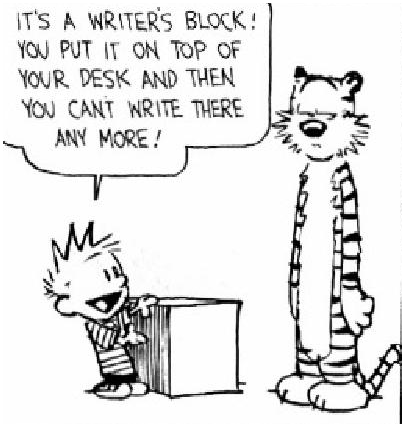
Writer’s block can come in many different forms.  For some it will mean they literately cannot write a word and stare at the screen, for others it means they can write but hate everything they do.  Others will get stuck coming up with ideas, whilst some will never finish a story as they don’t like the direction it is heading.  So what can we do about this?

Well, there are no hard and fast rules here, and no cure-all fixes.  Each writer is different and they may have their own way of tackling this issue.  I’m not saying mine is any better or worse than theirs – this is just what has worked for me when I wrote my two novels.

Firstly, let’s think about our writing environment.  If the only time you think about writing is when you sit yourself in front of your PC or typewriter you might be making life hard for yourself.  People often ask me how long I spend writing – as if it is a quantifiable amount of work that can be divided up and parceled out like an administration job in an office or bureau.  But the truth is that by the time I sit down and write the next section of a chapter or dialogue, I have already spent hours figuring out what I want to say or get across. 

‘How do I find the time?’ I hear you scream!

I achieved this by giving myself the thinking time I needed whilst doing other things.  Instead of getting the train, or driving to work each morning, I walked.  It took me over an hour but that’s not much longer than it used to take me to drive, and it didn’t kill me to get up 10-15 minutes earlier.  It gave my mind a chance to drift and wander into my writing, as I made my walk into work.  I was very fortunate to have a nice and pretty walk along the river Thames to enjoy, but equally this could be done by walking through any park or green space at lunchtime or free-time.  By the time I sat down to write at the weekends, I’d already have given myself plenty of time to turn over exactly what I was going to say.  This could be done during any form of exercise I guess, but you’ll want to free your mind of distractions – for example, I’d be doubtful of this being as effective by jogging whilst blaring my mind full of loud rock music through an iPod or phone.  But each to their own, I guess…

Okay, so you have now spent a few hours thinking about what you want to write before sitting down in front of the screen.  That’s good, but we still need to start writing.  This can be the next hurdle.  Writers are normally fine once they get started, but the perfectionist in all of us makes it hard to write that all important first word or sentence.  You’ve spent so long thinking about this, you just don’t know how to start! Arghh!!

Don’t worry, first things first, stop beating yourself up.  The self-recrimination only increases the cycle of frustration, so we need to give ourselves a break.  Open a new document up on your desktop and call it ‘scrap’ or ‘rubbish’ or some other derogatory word.  Then we will start writing our section here.  As we are only writing ‘rubbish’ or ‘scrap’ it doesn’t matter how it starts….it’s just rubbish.  My guess is that once you get going you’ll warm to the task and expand on all the thinking you’ve already done on this section of the book.  Then, once you hit your flow you can re-write that first sentence.  After you really get going you can polish it up, and then copy and paste it into the chapter you’ve been writing.

Even this trick won’t always help you however, sometimes your mind will be niggling away at you, telling you something is wrong.  This is where writers block can really kick in, but to understand it we have to understand where these blocks come from.  Sometimes it can be our subconscious telling us something we secretly know about, but don’t want to acknowledge, even to ourselves.

It might be a plot change, or a character introduction, or any number of things, that haven’t quite worked.  You are loathe to admit it and go back and change it because that might have happened back on chapter four, and you’re now on chapter twenty-seven and if you change it, you’ll have to modify all the chapters in-between! All that work!!

However, regardless of how much work it entails, your subconscious won’t let you get away with it.  It will continue to niggle away at you, until you make it right.  Unfortunately (or fortunately depending on your thinking) we may be able to fool some people but we can’t fool ourselves.  If you’re really unsure which way is best to go with your book, go back and make a copy and modify that one.  Then if you’re wrong, and the book was better before you made the change you can go back.  But my guess is that once you make the change, you’ll notice the release of pressure as the niggle finally goes away and you can move forward again with your book.  It might be a lot of work, but hey, nobody said this will be easy. 

Finally, I found it best to keep some sort of routine, or time when I wrote each week.  If you only write when you feel like it, that book may never be finished.  I used to set aside a certain amount of time each weekend, and then go on the odd writing holiday only accompanied by the dog.  If inspiration doesn’t come in those times you have set aside, do something else that helps progress the book.  For example, as I wrote historical novels, there was always more research to do.  Periodically whilst doing this research, a spark of excitement would grow inside me and I’d need to write about it…block gone and blasted before I’d even finished my session.  Again it will depend on your genre and your own personality.  My method may only work for me, who knows?

2 books on Roman cookery to give away!

Roman cookery

Today I have two copies of Mark Grant’s book on Roman cookery to give-away.   I used this excellent book on researching the food eaten by my characters in my novel Roman Mask.  Roman cookery is so intriguing because it is both so similar to our modern palettes, but also subtlety different.  The Romans were of course famous for lavish banquets, but Mark Grant focuses on what the normal people ate, rather than the over-indulgence of the few.  His recipes come from ancient writings and he attributes each source for each of the dishes.  The Romans used herbs and strong flavours and you can see the origins of the Mediterranean diet that we know today.    Having an authentic meal in a book is a great way to set a scene and instill a particular mood, and I found this book incredibly useful in my research.  It also comes in handy if you want to host a dinner party that has a unusual edge.  All his recipes can be compiled by gathering commonly bought ingredient’s today – so don’t worry, you want be confronted with a dish of marinated dormice for instance.  However, there will be a few staple ingredients that won’t be there,  as they only came into our diets after the discovery of the new world – so don’t expect any potatoes, tomatoes, peppers or chilies.

If you want the chance to win a copy of this book, simply post in the comment field the word ‘Hungry’ and next week I will draw two names out of the hat.  The offer is open to everyone wherever you live in the world, as long as you have a postal address I can send the book to.

Good luck!